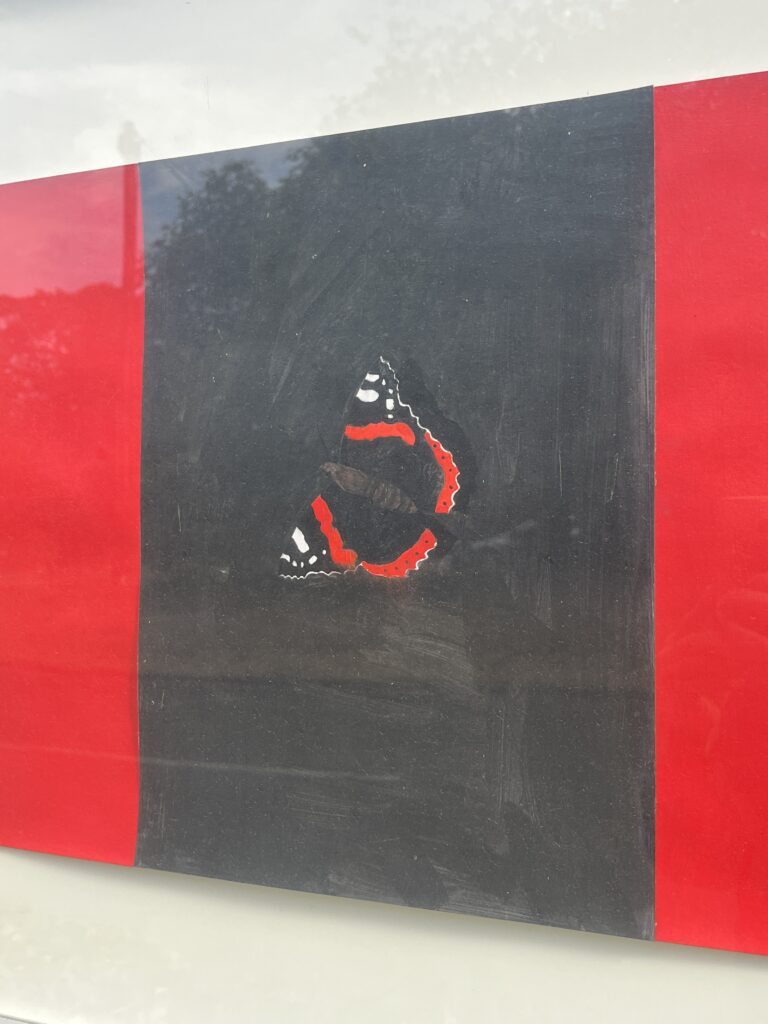
Exhibition 85 features a powerful painting by David Willetts and accompanying flag by Jeannie Freemam.
David says: My work is about the natural world and is often in serial form. This particular work is called “ARTERY” and the subject is endless loss and renewal. The work at the Notice Board is linked to a parallel work on my Instagram posts that will run concurrently. @david_willetts_painter
David was born in Birmingham and attended Birmingham College of Art followed by the Royal Academy Schools. He worked in the evenings to support himself as a student and beyond but eventually taught full time at the then Nottingham School of Art where he eventually became course leader on the BA and MA fine art courses. He continued painting and exhibited in several mixed and solo shows including the British Art Show and the Ikon and Coracle Press galleries from which paintings were purchased for public collections including The Arts Council and the Government Art Collection. David retired from teaching in 1993 to paint full time.
Hiding In Plain Sight by Tiffany Arntson features photography and woven elements. Tiffany says:
I looked at them for a long time before I came to touch the leaves and know what a gift they are. Tall, sword shaped spikes. Clustered in a jagged bush, New Zealand flax plants are hard to ignore. A friendly monster – depending on how you view them. This was my first encounter with these otherworldly plants, inherited in the garden of our new house. I feel shame to say I ignored them for three years. Yet they were steadfast in not needing anything from me. They kept growing, waving in the wind and each Summer they pushed up magnificent stems of orangey red flowers. Their determination was quiet and unwavering. The first time I tried to prune them I tossed away the leaves cut from the base. They were waste to me, I didn’t consider they had a use beyond. The second time, a year later, was different. My daily dog walks in the local fields opened up a new way of seeing and being with the land. I return home with treasures. Walnut shells, lichen on a piece of bark, a sycamore helicopter, a particularly pleasing stick. My family watches piles around our house grow, with eyes wide. Some of these finds became part of my art making. A new way of working with materials that speak to me without words. All this was in the back of my mind when it came to the second pruning of the New Zealand flax. As I cut the leaves I wondered if I could make with them. I discovered this plant, known natively as harakeke, is an iconic, exceptionally strong plant central to Māori culture. And, as all precious resources, it was heavily exploited in the colonisation of the country. For centuries Māori used traditional techniques to weave the inner fibre into everything from fishing nets and heavy mats to clothing. I came to see how precious the plant and its leaves are. I started experimenting, admittedly with an undisciplined approach. Beginning by weaving a grid, everything that comes next is a response to the place I’m in, the people I’m with and the stories being told. Frequently I pause, hold the piece in my arms, against my body, then place it on my head. It’s very calming in there, wrapped in the green aroma, able to see and not be entirely seen. It’s a place where I feel free.
Tiffany is an artist, communications consultant and host of creative residencies for artists, held near Stamford, Lincolnshire. Her art making celebrates the overlooked and under valued; natural elements found on daily walks and man made materials that have been discarded. With a playful, curious energy, she explores the question: what sustains us? It’s work that surfaces the unseen connections within ourselves, other beings and our environment. @anenglishrogue@rogue.residenciesroguematters.com
Thanks to neighbour Margaret and Grand View Care Home for their New Zealand flax, Ava and Meg for help in weaving these pieces with me and Lucy Glen for the photograph featured in the noticeboard.
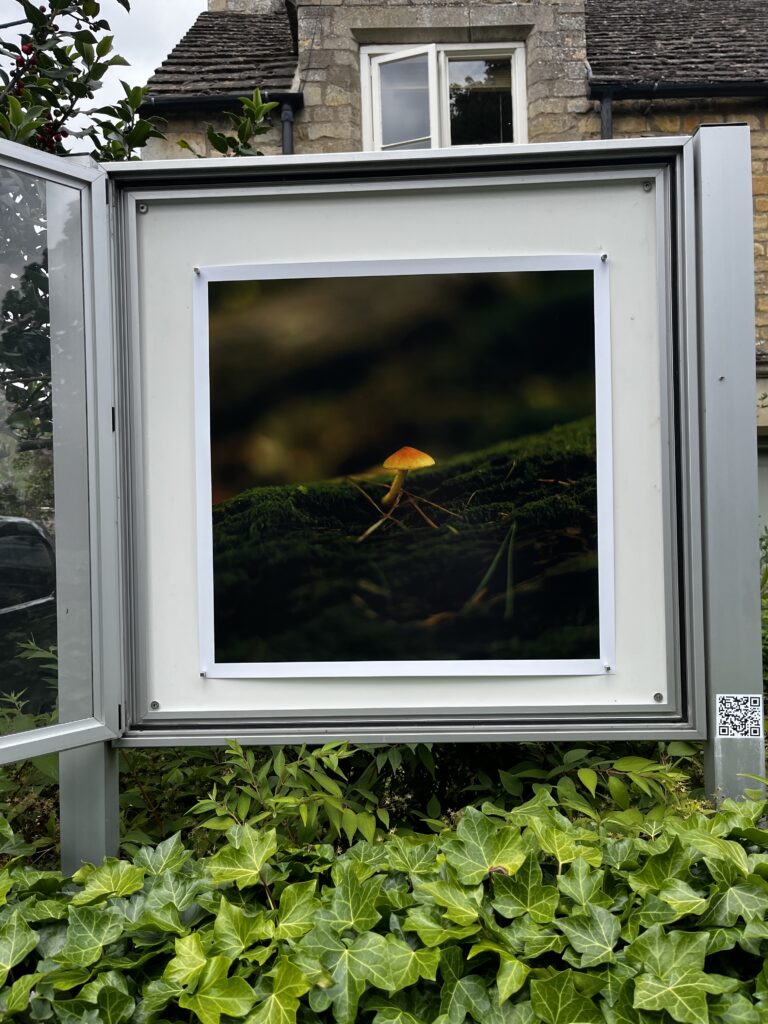
This months exhibition by Alex Costin is a digital photograph: Solitary Fungi. Alex says “Fungi has many connotations – magic – fairytales – sustenance – decay – poison but most of all, beauty. It has the power to take over spaces; demands respect and to be seen in all its prowess. Within the deep greens and browns of the woodland, stood a proud unwavering orange mushroom, just waiting to be appreciated, or not… it will keep thriving regardless. It is free to exist in a world that doesn’t always appreciate its complexities and beauty. “mycology is queer insofar as it is marginal, subordinate, contested, ridiculed, but more critically, mycology is queer insofar as it is disruptive, collective, transformative, revolutionary.” – Dr Patricia Kaishan When you delve into the complexities of Fungi you find a rejection of what would be considered “norms” and a whole world of wonder, magic and resilience that can connect humans and foster understanding and acceptance. This Solitary Fungi is a symbol of freedom and the beauty that comes with it.“
Alex Costin is a 28 year old queer, trans photographer based in Hull. Their work focuses on inclusivity, accessibility and fine art. He captures everything from the mundane to the magical, from portraits and weddings to live gigs and nature. Alex has been capturing moments since childhood and graduated from Sunderland University in 2019 with a degree in Photography, Video and Digital imaging.
Exhibition 82: The Path is by Clare Morris-Wright. Clare says: This zine was made as one part of a series of art works which showed what I had been doing over three years of observing an area of pathway which was a 1940’s perimeter path linked to a disused airfield near my home. The artist’s zine was conceived as a way of communicating with visitors and walkers along the perimeter pathway, the QR codes link to seasonal films I made. Over the three year period I had negotiated access with the landowner who had agreed to not clear or cut back anything. I carefully watched this area of land which hosted its own ecosystem, thriving with wild flowers and an incredibly rich habitat, despite it being mainly concrete, this pathway hosted a botanical list of tough plants who enjoyed the cracked surfaces of deteriorating concrete. The list of what I found is shown here too. I wanted the zine to show the close relationship I had built up with the path and to depict my interpretations of precious moments I had shared whilst regularly walking this pathway. Many art works were made and exhibited in a small barn near the path with some pieces going on to be exhibited at Cambridge University Center for arts research and the zine is now held in the permanent collection at The British Library and Glasgow Women’s Library. I see this path as a small part of what is available for us all to see in our everyday – the small gifts of nature, seasons and weather.
Claire Morris-Wright is an artist and one of the founding members of Knighton Lane Artists Studios and Leicester Print Workshop. Claire worked as educator and curator at Nottingham Castle Museum and Art Gallery and Leicester City Gallery. She has exhibited widely and was awarded Arts Council England development funding for The Path project.
Simon Woolham writes: 1st April 2026: ‘A journey from Macclesfield to Uffington and back again’ “We left Macclesfield at 1:30pm with a graphite pencil, paper, glue stick, scalpel, fixative, and a blank white flag. I had not met Kate before but knew she was an artist and a farmer. We travelled past Rudyard Lake, through the centre of Leek, past the edges of Ashbourne, Derby and Nottingham, through villages, over small hills, round the edges of Rutland Water, through the shining light stonework of Stamford and then on to Uffington. We parked outside Kate’s farmhouse, but we could not see any farm and we all needed the loo after a long(ish) journey so I called Kate (who was seeing to some sheep). After our quick toilet break I got straight onto taking graphite rubbings as the house, farmyard, village opened up, and I was instantly in a textural haven! After we all (myself, my wife Hannah and our children Ava and Lana) met Kate and her three sisters, everyone was super welcomed and brought into the farm rituals; feeding the lambs, watching chick’s being tended too with pipe-cleaners, we were at one with Kate’s place. I ventured to the church where I found textures from the fences, gates, tombstones, walls, architectural arches. From the textures of history from Kate’s extended home I made an artwork that fitted to the dimensions of the noticeboard and a flag, which I felt celebrated Kate’s place and its place in the village and beyond. Me and Kate had many conversations afterwards, with too many coincidences to mention, taking us to Wysing, Huddersfield, Leeds and back to Macclesfield………… “
Simon Woolham studied Fine Art at Manchester Metropolitan University followed by an MA from Chelsea College of Art in London (2000). Simon’s practice as an artist, curator and academic is centred around expanded drawing research and methodology and this was the focus of his practice-led PhD from 2012 and awarded in 2016 at Manchester Metropolitan University. The PhD explored walking (in the broadest sense) and narrative in physical, virtual, and psychological space, expanding on the notion of an artists’ residency of the mind. He was based at Wysing Art Centre between 2008 and 2012 and is currently based at Rogue Artists Studio.
Jamie Temple, for this exhibition Unfinished Baskets, is showing linocuts that are an evolving series of prints that sit somewhere between research, material study, and finished work. He says: “They draw on ideas and forms that continue to surface across my wider practice: structures that interact with natural forces such as wind and water, or in some ways act as visual references to the complex systems we move through and our attempts to control and channel them. The forms in the prints are drawn directly from the physical willow objects made while on a residency at Studio459 Tomar, capturing them part way through their making. The flag is scaled up from one of these linocuts — its movement in the wind in some ways echoing the intended use of the physical forms influencing the prints: shapes designed to catch wind or move through water, extending these ideas into a shifting, kinetic object much like many of my sculptures. During the residency, I became increasingly interested in basketry and working with willow. Surrounded by woven objects in the house and studio, and wanting to explore the craft of basketry while making use of leftover willow available. I began experimenting and reverse‑engineering baskets and other woven forms to work out their construction and some of the techniques used to make them. The slow, deliberate process of carving the lino blocks became a way of actively committing basket‑weaving techniques to memory: translating the gestures, patterns, and sequences of weaving into carved marks. They are ‘sketches’ of the physical objects; prints that carry traces of that material process and ground themselves in the movements of new skills developed during this period of research.
Jamie is an artist, educator, and curator with a practice grounded in relief printmaking and wood carving. Across works on paper, carved wooden sculpture, and mixed media installation, he draws from the built and natural environments we inhabit, traverse, and shape. His recent projects explore the interplay of dynamic systems — environmental, social, planetary, and human made — and how these structures influence our lives and surroundings. Informed by research, material exploration, and hands-on experimentation, his work opens up conversations around sustainability, ecological awareness, and the interconnectedness of all living things. Through these themes, he invites viewers to consider their relationship with the natural world and their role in shaping the futures we are moving towards.
Kat says: “Beyond the Fields is a photographic project that celebrates and documents the resilience of twelve women farmers from the North of England. Through large-scale portraits and accompanying narratives, the project sheds light on the precarious realities of northern farming, particularly the growing need for women to diversify their livelihoods by pursuing second careers outside agriculture in order to sustain their land and communities. Each farmer is photographed in two contrasting settings: on their farms, where they work the land and tend livestock, and in their secondary roles beyond agriculture. This dual perspective highlights the layered lives of these women, whose work often extends beyond the farm gates to sustain rural life amid economic pressures, climate change, and shifting agricultural policy. Shot on medium-format film, the images capture both the intimacy and scale of these women’s lives. By pairing pastoral and non-agricultural settings, the series challenges romanticised notions of farming and offers a more nuanced, contemporary portrait of rural resilience. Beyond the Fields also aims to spark wider conversations around food sovereignty, rural gender dynamics, and the often unseen cultural labour involved in sustaining marginal farming communities. These women are frequently the glue holding together households, farms, and wider rural networks, and this project seeks to give them visibility, voice, and recognition.“ Kat is an artist and creative director working across photography, food, and community-led practice. She graduated in Fine Art Photography from The Glasgow School of Art and is a recipient of Portrait of Britain. Alongside her artistic practice, she works as a freelance portrait photographer for The Guardian. Kat is also Creative Director of The Landing CIC, where she leads projects that integrate art, ecology, and collective learning, with a focus on sustainability, skill-sharing, and connecting urban and rural communities. For more information: www.katwood.uk
Exhibition 78 features work by Tom Martin of the Participatory Action Research group connected to the project ⵜⴰⵖⵓⵔⴰⵔⵜ. The Participatory Action Research project used co-produced creative strategies to understand gender issues in Morocco and amongst Indigenous Amazigh women, specifically in terms of their experiences of climate change. ⵜⴰⵖⵓⵔⴰⵔⵜ – the project’s title – means ‘desertification’ in the Tamazight language. The project was awarded the Emerald Publishing ‘Real Impact Interdisciplinary Fund Award’. This funding allowed the project team to run participatory photography workshops with local Amazigh women in a rural village in Aoufous in November 2022. Tom Martin says: The images created illustrate the far-reaching consequences of climate change on these women’s daily lives. This project aims to show how climate change – and specifically the process of “desertification” – is threatening the survival of traditional Amazigh livelihoods and is disproportionately impacting women and girls. The Amazigh flag holds a strong meaning for the people – a symbol uniting the indigenous groups and challenging colonial boundaries. As we approach COP29, with the theme “Solidarity for a Green World,” it is critical that the voices of those most affected by climate change—particularly women and indigenous communities in the global south—are heard and included in decision making. Their lived experiences and locally-informed solutions offer invaluable insights for policymakers shaping the future of climate action. A co-produced book has been published by Emerald, summarising this project. This book is timed to be released during COP29, aiming to inform policymakers about the challenges facing indigenous people, and advocate for their cause. This project aligns with Sustainable Development Goals, SDG5, Gender Equality, and SDG13 Climate Action.“
Participatory Action Research Team: Tom Martin – a Humanitarian photographer and lecturer at the University of Lincoln. Michelle Walsh – senior lecturer and photovoice practitioner at the University of Lincoln Dr Kaya Davies Hayon – lecturer in Francophone Maghrebi Culture at the Open University Dr Fadma Aït-Mous – assistant professor of sociology University Hassan II, Morocco and UK mentor. Professor Stephanie Hemelryk Donald – professor at University of Lincoln
John is a landscape gardener and a self taught photographer. He lives in the heart of the Lincolnshire Fens and captures the natural world that surrounds him.
“I’m a naturalist. I was brought up by my grandparents in a cottage in a little village on the Fens and I spent hours watching and learning about wildlife and insects. They helped me understand what I saw. I continue to have a passion for the natural world, its conservation and the education of those who know less or want to know more. In between work, early in the mornings or late at night I go out with my camera. Sitting often for hours waiting for the right light, waiting for the deer, hare, birds to make the shot perfect. I lay still and also enjoy what I see around me. I share my photos on instagram under the name SnipSnaps
Georgina Barney is an artist based at Primary, a contemporary art complex in Nottingham where she oversees a dye garden, growing plants to make dyes, inks and paints. Georgina shares these skills through her workshop enterprise Plant Dye Studio. Georgina says: Weld (Nottingham Ring Road) is what it says it is. The plant is exhibited in the noticeboard, and the silk dyed with it is the flag. Weld is an historic dye plant, used for centuries in Britain for yellow and to make the famous ‘Lincoln Green’ associated with Robin Hood (first dyed blue with woad). As weld grows in the most inhospitable of places including roadside verges, it feels like a post-apocalyptic plant. A plant for the future and the past. It’s also a very urban one. It’s a wave from a roadside in Nottingham to one in Uffington… When people ask me what I make, I say I make colours from plants. I make dyes, inks and paints. When people ask me what I make with those, it gets harder to explain. Often, the point is purely the process: of seeing what colours emerge and living with those for a while. It teaches me to let go and live with the imperfect; that in fact, the imperfect is beautiful. Sometimes, as in the Noticeboard United project, there needs to be a resolution, a thing. I try to keep it as simple as possible. The colour is the artwork. All I try to do is resolve the material into a form that keeps the colour as the centrepiece.