Art History show at Haarlem. Opens 16th Feb

Art History – can you draw me a diagram opens on Saturday 16th at 7pm at Haarlem Artspace in Wirksworth. It’s a show I’ve Curated with David Gilbert using all the artworks I still have in my studio. I’ve also made some prints to accompany the show that are for sale with 50% of sales going to support Haarlem Artspace. See in the shop for more info.

As I emptied my space of the last 12 years of work it was nice to see old work anew, remember people I’ve worked with and places I’ve explored. It was difficult too, seeing the same ideas worked and reworked with no concrete solution found! David and I have written this to accompany the work

Art History: Do you want me to draw you a diagram?
Our art culture makes no attempt to search the past for precedents but transforms the entire past into a sequence of provisional responses to a problem that remains in intact. Georges André Malraux  
There is always a temptation to try to come up with a Universal Theory of Everything, to understand or make sense of what we are doing and making. This has been at the core of the work David and Kate have undertaken in relation to Kate’s practice and its outcomes. Since 2008 they have come together repeatedly to look at Kate’s work and have often used diagrams by leading cultural theorists to think with and describe its repeated re-iterations. But all these diagrams, and Kate and David’s, have proven to be inadequate. All are – inevitably – provisional responses.  
This collaboration has seen them looking back over Kate’s archive of work and considering its current concerns against those of 2008, which placed Kate and her work in the Wider World. In response, they have generated this show and a new diagram which attempts to redefine the relationship between Kate, the work and the Wider World.  The layering of the work on the walls and tables is deliberately archaeological and is a direct attempt to visually undermine a linear historical narrative. It creates physical and temporal overlaps and allows unexpected glimpses of works in each other.
Residency at Bromley House Library begins

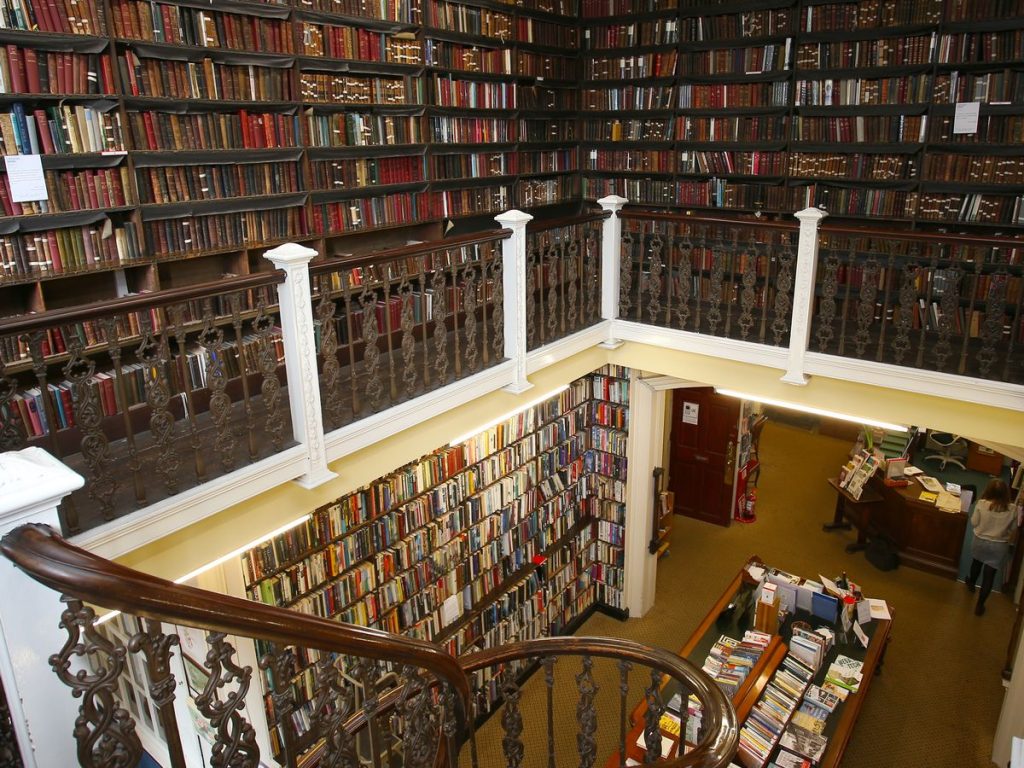
I’ve received ACE funding to support a residency at the BHL and Five Leaves Bookshop in Nottigham City Centre – to explore and consider the role of these places on the lives of their users. The funding will enable me to work alongside staff, library members, customers and visitors, creating new works in response to research.

TIn getting started I held a free workshop at BHL yesterday, using the Alan Sillitoe and the Sundial Society archives as catalysts. We talked about the idea of books, bookshop and libraries being Refuges and how using the words of others can help us say something we cant.

Abbott Hall. Kendal.

abbot Hall gallery

I’ve been invited to work by Lakelands Arts at Abbott Hall to develop ideas in response to their upcoming show ‘Refuge – the art of belonging’. An exhibition featuring artists who settled in the Lakes after being displaced due to religion, politics or the type of art they make. Their ambitions for this commission is to bring new audiences to the gallery and build better relationships with communities who live nearby.

Becalmed/Grounded/Made-ready? –

While adapting found postcards of Heachem I’ve been thinking about the real house/boat/houses found behind the dunes. My postcards are in one sense useful ‘thinking through doing things’ or ‘thoughts in the act’. Undertaken to understand and question both the work and the boats. All of which made me realise that this is in many ways waht the boathouses are too – ‘thoughts in the act’. Sites where intangible knowledge, feelings, innate behaviours, skills are revealed as form and like the thoughts that made them – changing, adapted and abandoned when neceessary.

Venice Architecture Biennale


Island at the UK Pavillion is a great work and gets better the longer you think and read about it. I was really happy to see and experience it, then consider its ambitions in relation to my own. But on the way to the Gardini I was reminded of the everyday attempts at keeping things going and of care which aren’t seen as art.  As Yeats says: The world is full of magic things, patiently waiting for our senses to grow sharper. 

Art History – can you draw me a diagram. Haarlem Artspace

Curator David Gilbert and I are happy to be working at Haarlem Artspace in Wirksworth, Derbyshire, next February on a new show of my work: Art History – can you draw me a diagram. I am making available everything I’ve made in the last 15 years for him and I to select from. We will draw more new diagrams to try and understand what it all means. Then oin early March, we will invite people to join us in a conversation over dinner at a closing event.

Hull:New Commission

I’ve been offered a new commission to work alongside 3 Ways East in Hull on a research phase of their new initiative. The work will take place in two parts of the city that face significant and complex challenges but that are also full of untapped assets and promise. My work will take a creative approach to the question of how communities and places can best flourish.

Rurality Re-imagined: Villagers, Farmers, Wanderers and Wild Things

This new book contains a chapter I’ve written about the importance of Improvisation. It also features my work Instar and items from the Farm Archive.
George McKay has reviewd the book and says: This sparkling collection of essays, photographs, artwork, creative writing and meditations represents a sustained exploration of and contribution to cultures of the countryside and the liminal spaces of the non-urban. Through it we see the contemporary rural in cultural glimpses and social practices, as we seek to make sense of our desire to escape to or from its diminishing scope. It will be of fascination to today’s pastoralists and re-wilders, but it should absolutely be read too by cool artists of the city, urban designers and policy-makers alike, indeed by anyone curious about life and culture in 21st-century landscapes.

“All the seas are fields”

I’ve spent the last 2 days working at Metal Peterborough making a chalk and charcoal drawing. Taped lines extend into the room and sat alongside pressed clay forms. It’s a short lived intervention that, like the drained Whittlesea Mere it was based on, will disapear in a flood of water.

Images from worksheets/feedback

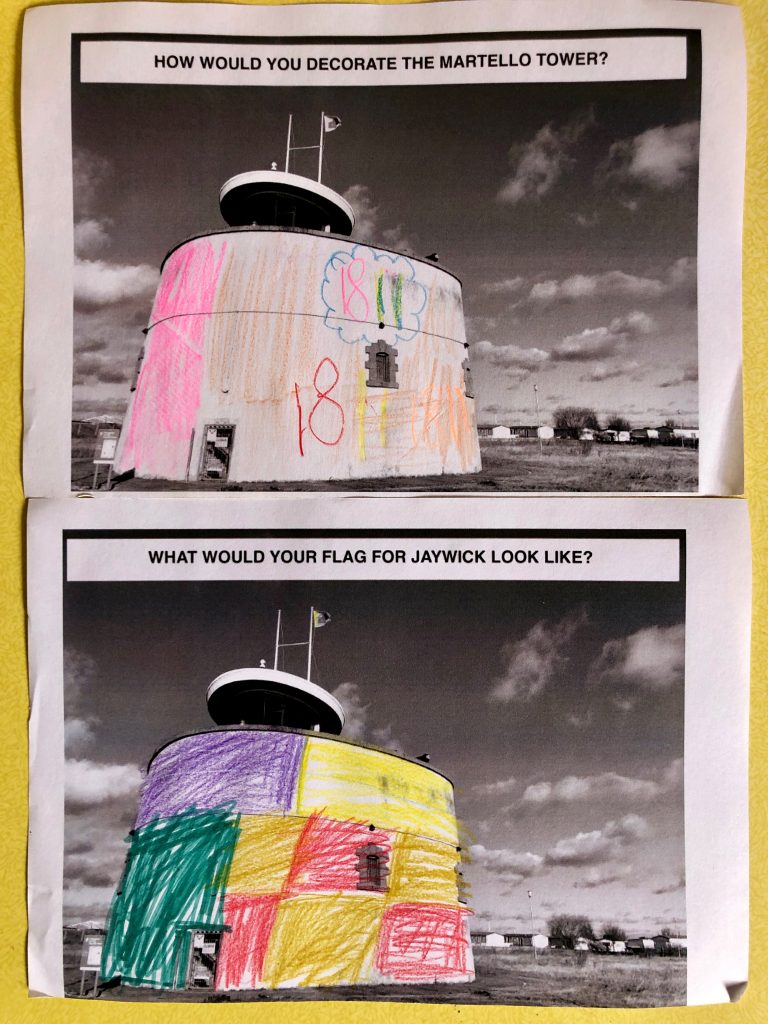
I really like these colouring in sheets visitors, to my show, at the Martello Tower, Jaywick have made. They of course reveal a weird parallel to the projected images from last weekend. I’m not sure which came first my projection or their mark-making, either way I’ve only just found them. I’m pleased that visitors consnected the tower with being colourful and visible, as I do. These dramatic designs declare the landmark that both bears witness and is seen in return.