F.E.A.S.T.2

Hosted in unique spaces F.E.A.S.T. brings people together over locally sourced food to discuss sustainable farming, the environment and culture.
F.E.A.S.T. aims to encourage debate by linking social, environmental, scientific and cultural thinking in an artful way.   F.E.A.S.T. began last year with a  successful event at Uffington Village Hall.
In early 2020, Kate and Liz will be  at Caythorpe and Frieston Village Hall on March 20thand 21st.  F.E.A.S.T. has been created by sisters Kate and Liz Genever; an artist and scientist respectively but also farmers. The family own a traditional mixed farm in a village in South Lincolnshire. Agriculture and its related concerns are central to their work, as is encouraging people to think, reflect and do.
F.E.A.S.T has two distinct elements:  1: A Free Exhibition of a professional artists work relevant to the local landscape and F.E.A.S.T themes. Open across both days between 2 and 4 pm where the artists will happily meet visitors and talk about their work. Complimentary tea and cakes will be available. 2: A Dinner which offers a social atmosphere, delicious food and an opportunity to develop a deeper understanding. Each meal is opened with provocations from both the arts and science on sustainable farming and the environment. These will start the conversations, with everyone being involved in the discussion. We welcome guests with a wide range of interests, backgrounds and specialisms.
F.E.A.S.T. utilises locally sourced ingredients, including surplus food to produce a range of plant and animal-based dishes. Each dinner lasts three hours and has 25 places. The dinner runs between6 – 9 pm and costs £25.
F.E.A.S.T is supported by Invest SK 
For more information and/or to book at place for the meal: kate@kategenever.com or liz@lizgenever.com                 

Comparison the thief of joy?

The Consequences of not coming together was initially discussed as we started the session at Metal on Thursday evening. In many respects the answer is obvious…. we, I believe, inherently know that connection through close conversation offers support, kindness and the promotion of understanding. These goals sit at the heart of this project, alongside the removal of any judgement.  Interestingly though the word judgement was challenged, to be replaced perhaps more suitably with comparison? Comparing, it was argued, enables us to turn a negative script back onto ourselves creating self criticism.
This provided a great conversation topic adding to others that arose – all of which we’ve gathered as catalysts for the next sessions…
If your interested in getting involved in this city wide project aimed at women then email sarah@metalculture.com

I make you and you make me

I’m pleased to have been offered a small commission by Peterborough Presents to support their Heritage Lottery project in Millfield. My proposal I make you you make me grew out of the work I’ve done in the area while also building on my interest in considering how we all make and respond to changes. My wider proposal is informed by Raymond William’s book Culture is Ordinary and in particular a journey, he describes, where he passes through the countryside to the city, passing factories, a cathedral, a university, a teashop, a pub. He encourages us through this description to see the simple, necessary and ongoing shaping and interconnected loop between ourselves and place – places shape us and then we shape them. This leads him to argue for the end of a belief or an approach that art and making is for and by an elite. 

Always go too far… reflective

A 3 days pilot project Always go too far, funded by NCCD Leeds, with Therapist Georgia Cooper and Dancer Phil Sanger in October has produced some interesting reflections. What seems significant is the line in Phil’s: It was not intended that the process is repeatable, but that a container is constructed… in which desire can flourish, absent of leadership. This reinforces my current desire to generate work that centres around ‘drawing together’ rather than ‘drawing of’ – which of course is another form of improvised architecture.

The Notice Board: Poly-Technic

Poly-Technic
Title: Never-Land
Poly-Technic asks: What will Europe look like in 200 years? Can we imagine a place where national boundaries have evaporated, where everyone belongs, and nobody stands on the in or outside? The last 200 years has seen many wars, many struggles, many generations. Communism has risen and fallen; capitalism reaches its end stage; the impact of climate change becomes ever more urgent. At this point in time we want to think to a better time, challenge negative scripts and acknowledge the possibilities for a future that understands itself. A future not tied into the present state of things.
The flag is one outcome of a European project involving many authors of different ages and experiences. In each Never-Land site we have tried to think forward, imagining together taking collage literally and metaphorically in considering a different Europe. We acknowledge the students and staff of Liceo Artistico Guggenheim School in Venice, participants of a workshop at Leicester Printworks and audiences at Yorkshire Artspace, Sheffield for their part in the process of creating a Never-Land.
www.poly-technic.co.uk

The Notice Board: PESPE

PESPE Poland.
Title: Land of the free
Pespe says: I am a graduate of Graphic Design at the Academy of Fine Arts in Gdansk and work as a graphic designer. Silkscreen is my hobby, it meets my needs for manual action. I hang works in the city because I want to familiarize people with artistic graphics. I work mainly in the Tri-City (Gdańsk, Gdynia, Sopot) to show people that graffiti does not have to be the only form of street art. I hang work at night to leave a mark in the city where everyone is anonymous. This give meaning to my work, and is not just to put in mothballs. Besides, sometimes I like to feel the adrenaline 😉 The form and subjects of my posters are the results of my personal preferences – I do what I like. I am inspired by old-school animations, weird characters and abstract figures, but at the same time I have in my mind design artistry and the harmony of the composition. I try to combine a sensitivity with the graphic clarity of the form. I like that everyone can see something different in these works.
#pespe95  

Fermynwoods Walk/Talk with Carole Wright

I’m pleased to have been invitied to be part of this: Art + Psychogeography: Tuesday, 12 November 2019. Join us all from Fermynwoods for a free walk and talk event exploring how environments can effect emotions and how walking can be seen as way to creatively explore different places, with a focus on the rural. We’ll explore the village of Kings Cliffe in the company of artist Kate Genever and community walker Carole Wright, discussing how psychogeography inspires their practice, starting and ending up at The Cross Keys pub. 7 – 8:30pm. Starting and ending at The Cross Keys. 2 West Street. Kings Cliffe. PE8 6XA.

The Notice Board: Katie Numi- Usher

Katie Numi-Usher. Belize. Central America
Title: Borderlxne Lino Print. 30cm  x 40cm Edition of 7
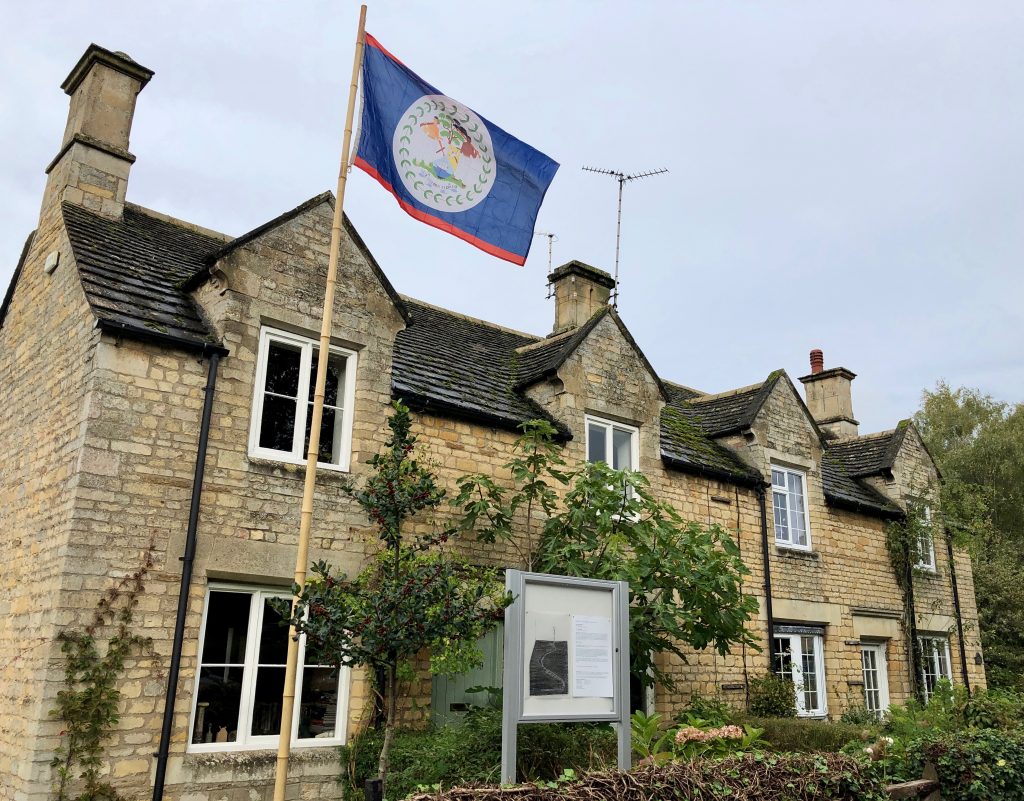
The Notice Board in hosting the work of Katie invites you to consider the construction of personal and national identities and notional ‘Free Lands?’  Belize is composed of many cultures and languages. An ancient Mayan history is well documented with many cultural aspects still persisting today, despite 500 years of European domination – first by Spain and then Britain. The British colonised the country in the early 18C using black slaves from West and Central Africa to cut trees. Their eemancipation was not achieved until 1838 [even though abolition was penned in 1833], but this provided little change as many institutions restricted the ability of individuals to buy land. Fallout from this and earlier histories continues to resonate as citizens fight for land, equality, safety, prestige and struggle against rising crime, racism and poverty. But why is this relevant here 1000s of miles away in a small country village? The Notice Board proposes that Katie’s work and its wider context may enable us consider the repercussions of historical decisions on people, economies and countries. Whilst helping us reflect on our own identity and inevitable diverse heritage. The national flag of Belize is flown to highlight Katie’s country of origin.
Follow this LINK for further information about The Notice Board   
Katie says: This lino print represents a 40 foot hair braid bursting out of a canvas on a wall installed in an exhibition in Belize. The braid was made of extensions I had during 2018. Through these two artworks I aim to weave my ‘silenced-ness’ into a wider narrative. It’s about personal borders bridging political ones. Hair is a powerful part of black identity. On the continent it was how we connected with our ancient ancestors, braiding like the planted cornrows. When we were taken away our hair was shorn and we were scattered by language. We were told our hair needed to be relaxed. We were told and shown and done to a great deal.
Instagram: katienumi                  
Twitter: @kat_ush_kin         

Speaker at Great Community Venice/Ca Foscari.

As part of the  ‘A great community- John Ruskin’s Europe’ conference in Venice. I was invited to make new work – a previous post shows initial collages of ‘future skies’. During the conference speakers from diverse specialisms talked of ruins, roads and routes, paradises lost, economics, parables, morals, virtues and concepts of collectivism. I spoke of collage and is ability to warp realities and how there is a push and pull that allows you to play with space, perspective, reality. fantasy. I like how it Emphasises concept and process over end product, collage brings the incongruous into meaningful congress with the ordinary. In response to the speakers papers, multiple languages used and ambitions of the conference, I made a new collage and then drawing that referenced all their ideas. The work contains references to the spaces and artworks I saw during the visit alongside mythical places – utopias perhaps such as the Tower of Babel